



Table of Contents
- Why Science Backed Skincare for 50s Works Differently
- The Best Anti-Aging Ingredients for 50s Skin
- How to Treat Deep Facial Lines With Science Backed Skincare
- Managing Hyperpigmentation and Age Spots
- Barrier Repair, Hydration, and Transepidermal Water Loss
- Layering Active Ingredients Without Irritation
- Building a Complete Science Backed Routine for Your 50s
- Frequently Asked Questions
Last Updated: September 27, 2026
Why Science Backed Skincare for 50s Works Differently
Science backed skincare for 50s starts with accepting an uncomfortable fact: your skin at 52 does not behave like your skin at 35, and products built for younger skin often underdeliver because they target the wrong problem. At Ageless Forever by Dr. Campos, we see this constantly. Someone buys the same retinol serum she used for a decade, applies it exactly as before, and wonders why her skin looks drier and duller rather than smoother.
The reason is structural. By your fifties, several changes stack on top of each other: declining estrogen, slower cell renewal, and a thinner dermis with less collagen and elastin to work with. A formula has to address those shifts, not just surface texture.

Hormonal Shifts and Their Impact on Skin
Estrogen decline during perimenopause and menopause reduces oil production, slows wound repair, and accelerates collagen loss. Many women notice their skin becomes simultaneously drier and more reactive, which is why a product that felt gentle at 45 can sting at 55.
This hormonal piece is the angle most generic guides skip. It matters because it changes what you should prioritize: barrier support and hydration move up the list, while aggressive exfoliation moves down.
Cellular Turnover and Collagen Synthesis Slowdown
Cellular turnover is the process by which skin sheds old cells and replaces them with fresh ones. In your fifties, that cycle lengthens, so dead cells linger and light reflects unevenly, which reads as dullness.
Collagen synthesis declines in parallel.
The Best Anti-Aging Ingredients for 50s Skin
The best anti-aging ingredients for 50s skin fall into two camps: renewal agents that speed cell turnover, and support agents that rebuild the matrix beneath the surface. You need both. Leaning on one alone is the most common mistake we see.
Retinoids and Vitamin A: The Gold Standard
Retinoids remain the most evidence-supported topical for photoaging. They work by binding to retinoid receptors in skin cells, which speeds turnover and supports collagen production over time.
Vitamin C, Peptides, and Antioxidants
Vitamin C is an antioxidant that neutralizes free radicals from UV exposure and supports collagen synthesis. Used in the morning under sunscreen, it adds a layer of defense that no other ingredient provides.
How to Treat Deep Facial Lines With Science Backed Skincare
Learning how to treat deep facial lines means accepting a limit: topicals soften and slow the formation of lines, but a line etched into the dermis over a decade will not vanish from a cream. What a well-built routine can do is reduce depth, improve the surrounding texture, and stop new lines from setting.
Why a Line Becomes "Set" in the First Place
A fine line is a crease in the epidermis. A deep line is a structural problem in the dermis. When collagen and elastin fibers break down faster than they rebuild, the skin loses the scaffolding that keeps a crease from folding permanently. Repeated muscle movement then presses that crease deeper, and the fold becomes a fixed feature rather than a temporary expression.
The Three Levers That Actually Move Deep Lines
1. Stimulate collagen synthesis. Retinoids remain the most evidence-supported topical for photoaging because they bind to retinoid receptors in skin cells, accelerate turnover, and support new collagen over time. Peptides work through a different pathway, short amino acid chains signal skin to build more support structure. Copper peptides in particular have gained attention for supporting dermal renewal.
What to Realistically Expect, and When
Most practitioners find that consistent use of a retinoid plus a peptide serum produces visible softening of fine lines in eight to twelve weeks, with deeper lines responding more slowly, often over several months, and never disappearing entirely. The honest framing: you are not erasing a decade of collagen loss, you are rebuilding enough support that the crease reads shallower and the surrounding texture looks smoother.
Managing Hyperpigmentation and Age Spots
Age spots and uneven tone respond well to a consistent brightening routine, but they require patience and daily sun protection or they return. Pigment that took years to surface fades over months, not weeks.
Barrier Repair, Hydration, and Transepidermal Water Loss
Transepidermal water loss is the amount of moisture that evaporates through the skin's surface. In your fifties, a thinner lipid barrier lets more water escape, which is why skin feels tight even when you moisturize.
Layering Active Ingredients Without Irritation
Layering actives is where good intentions go wrong. More actives is not better; the right sequence and spacing is what determines results.
Follow this order, thinnest to thickest:
- Cleanser
- Water-based serum (vitamin C in the morning, peptides or hydrating serums anytime)
- Treatment serum (retinoid at night only)
- Moisturizer
- SPF in the morning, always last
Building a Complete Science Backed Routine for Your 50s
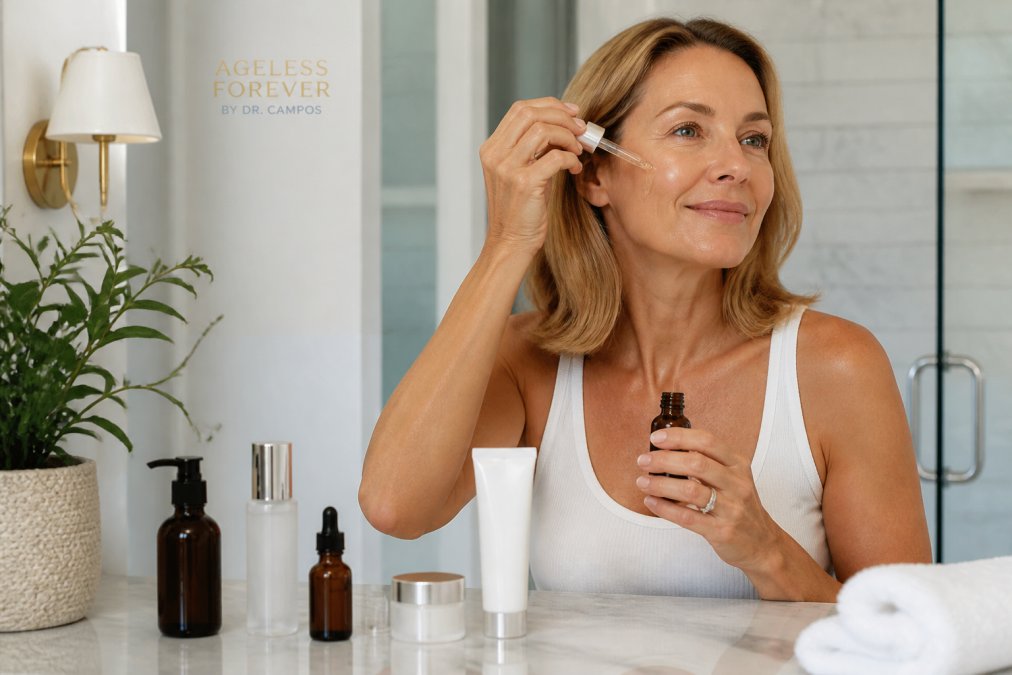
A complete routine for your fifties is simpler than the shelf in most bathrooms suggests. Morning is about defense; evening is about repair. What changes in this decade is not the number of steps, it is the priority order behind them.
Why the Priority Order Shifts After 50
Estrogen decline during perimenopause and menopause reduces oil production, slows wound repair, and accelerates collagen loss. The practical consequence: barrier support and hydration move up the list, while aggressive exfoliation moves down. A routine that worked at 45 can actively irritate skin at 55 because the barrier has less margin for error.
The Core Routine
| Step | Product Type | When | Purpose |
|---|---|---|---|
| Cleanse | Gentle or glycolic acid cleanser | AM + PM | Resurface and prep without stripping |
| Protect | Vitamin C mist or serum | AM | Antioxidant defense against UV free radicals |
| Treat | Retinoid or peptide serum | PM | Renewal and firmness |
| Hydrate | Barrier moisturizer with ceramides | AM + PM | Reduce transepidermal water loss |
| Shield | SPF 50 | AM | Prevent photoaging and pigment return |
A structured system removes the guesswork. The Antiaging Essentials Set bundles a glycolic acid cleanser, antioxidant mist, collagen booster serum, peptide eye cream, brightening anti-aging crème, SPF 50 mineral shield, and an NAD+ supplement into one regimen built to support renewal, hydration, and protection together.

The Drugstore Version of the Same Science
The active ingredients that carry the evidence, retinoids, vitamin C, niacinamide, ceramides, hyaluronic acid, and broad-spectrum sunscreen, are not exclusive to premium lines. The same mechanisms work at a lower price point; what differs is formulation elegance, concentration transparency, and how pleasant the texture is to use consistently.
The Lifestyle Pillars Most Guides Skip
Topicals are only part of the picture. Three lifestyle factors have real, measurable effects on skin in this decade:
- Sleep. Skin repair peaks during sleep, and chronic short sleep is associated with faster signs of aging and a weaker barrier. Seven to nine hours is the target.
- Diet. Adequate protein supports collagen synthesis, and antioxidant-rich foods help counter oxidative stress. Extreme restriction tends to show up on the skin first.
- Stress management. Elevated cortisol is linked to barrier disruption and slower repair. This is not a soft recommendation, it is a variable that affects how well your topicals perform.
The Timeline to Expect
Consistency beats intensity. Four weeks in, most people notice better hydration and texture. Eight to twelve weeks is when fine lines and tone begin to shift. Barrier improvements often show up first, less tightness, less reactivity, which is the signal that the rest of the routine has room to work.
Frequently Asked Questions
What is the best skincare routine for a 50 year old?
A science backed skincare routine for your 50s should include a gentle cleanser, a vitamin C antioxidant serum in the morning, a retinoid at night, a peptide or copper peptide serum, a barrier-repair moisturizer with ceramides and hyaluronic acid, and a broad-spectrum SPF 50 every morning. Consistency matters more than the number of products. Start with three or four essentials and build from there as your skin tolerates each active ingredient.
How does skin physiology change in your 50s?
In your 50s, collagen synthesis drops sharply, often accelerated by menopause-related estrogen decline. Elastin fibers degrade, dermal thickness decreases, and cellular turnover slows, which leads to fine lines, deep wrinkles, and loss of firmness. Barrier function weakens, increasing transepidermal water loss. Sebum production drops, making skin drier. These changes mean your skin needs targeted active ingredients and richer moisturizers than it did in your 30s and 40s.
How do you layer skincare products for maximum absorption?
Apply products from thinnest to thickest consistency: cleanser, toner or mist, water-based serums, retinoids or treatment serums, eye cream, moisturizer, and SPF in the morning. Wait 30 to 60 seconds between layers. Avoid using retinoids and strong acids in the same session if your skin is sensitive. Niacinamide and hyaluronic acid pair well with most actives. If irritation occurs, alternate nights rather than layering everything at once.
Can medical-grade skincare improve deep facial lines?
Medical-grade skincare with higher concentrations of clinically studied actives can visibly soften deep facial lines over time. Retinoids stimulate collagen synthesis and cellular turnover. Copper peptides support dermal remodeling. Hyaluronic acid and ceramides plump and hydrate. Results typically appear in 8 to 12 weeks with consistent use. For lines already etched into the dermis, combining science backed skincare with in-office aesthetic treatments delivers the most noticeable improvement.