



Table of Contents
- Understanding Sun Damage: What UV Exposure Does to Your Skin
- How to Repair Sun-Damaged Skin at Home
- Best Ingredients for Sun-Damaged Skin
- Dermatologist-Recommended Sun Damage Routine
- Professional Skincare for Sun Damage: What Sets Clinical Formulas Apart
- Skin Type-Specific Protocols for Sun Damage
- Post-Treatment Recovery: Supporting Your Skin After In-Office Procedures
- Conclusion: Building a Professional Skincare for Sun Damage Plan That Lasts
- Frequently Asked Questions
Last Updated: September 26, 2026
Understanding Sun Damage: What UV Exposure Does to Your Skin
Professional skincare for sun damage starts with understanding what UV exposure does beneath the surface. UV radiation breaks down collagen and elastin, triggers excess melanin production, and generates free radical damage that accelerates photoaging. This guide from Ageless Forever by Dr. Campos covers what happens at the cellular level and how to reverse as much of it as possible.
Photoaging vs. Natural Aging
Photoaging is skin aging caused by UV exposure, distinct from chronological aging. Naturally aged skin thins gradually and develops fine lines; photoaged skin shows deeper wrinkles, uneven tone, rough texture, and stubborn hyperpigmentation. The two overlap, so a dermatologist-developed approach targets both.
How to Repair Sun-Damaged Skin at Home
Consistency beats intensity when repairing sun-damaged skin at home. A daily routine built on gentle cleansing, antioxidant protection, retinoids, and broad-spectrum SPF produces visible improvement over several months.
A Step-by-Step Home Repair Routine
- Cleanse gently each morning and night to support the epidermal barrier.
- Apply a vitamin C serum in the morning to neutralize free radical damage.
- Follow with a moisturizer containing ceramides and niacinamide.
- Finish every morning with broad-spectrum SPF 50, reapplied through the day.
- Use a retinoid at night, starting two to three times weekly.
- Add a chemical exfoliant once or twice weekly to boost cellular turnover.
- Introduce peptides and DNA repair enzymes for wrinkle repair support.
Best Ingredients for Sun-Damaged Skin
The best ingredients for sun-damaged skin have dermatologic research behind them: retinoids, vitamin C, niacinamide, peptides, and DNA repair enzymes. Each targets a different part of the repair process, from collagen production to pigmentation control. What separates a routine that works from one that stalls is knowing the mechanism, the timeline, and the conflicts between actives.

Ingredients Backed by Dermatologic Research
- Retinoids (tretinoin, adapalene, retinaldehyde, retinol): Bind retinoid receptors to speed cellular turnover and support new collagen. Prescription tretinoin is the most studied; over-the-counter retinol is weaker and must convert in skin, so it takes longer to show results, expect 12 weeks or more for fine lines to soften.
- Vitamin C (L-ascorbic acid): A water-soluble antioxidant that neutralizes free radicals before they damage collagen and supports even tone by limiting excess melanin production. It is the most researched form but the least stable, it oxidizes with light and air, turning orange or brown. Look for opaque, airless packaging; it is often paired with vitamin E and ferulic acid, which slow oxidation.
- Niacinamide: Strengthens the epidermal barrier by supporting ceramide production and helps reduce visible hyperpigmentation by limiting melanin transfer to skin cells. It is one of the most tolerable actives, making it a good first step for sensitive skin.
- Peptides: Short amino acid chains that signal skin to support its own collagen and elasticity. Gentler than retinoids and useful for skin that cannot tolerate stronger actives, but the evidence base is thinner and results are more gradual.
- DNA repair enzymes: Help skin address UV-induced cellular damage by supporting its own repair mechanisms. Usually found in post-sun and post-procedure formulas rather than as standalone treatments.
- Hyaluronic acid: Replenishes moisture in compromised, sun-exposed skin. It holds water in the upper layers, plumping the appearance of fine lines, but does not rebuild collagen or fade pigment on its own.
How to Combine Actives Without Wrecking Your Barrier
Stacking actives is where most home routines go wrong. A few rules keep it working:
- Vitamin C and retinoids do not belong in the same step. Vitamin C works best at a low pH, retinoids at a higher pH; together they destabilize each other and increase irritation. Split them: vitamin C in the morning, retinoid at night.
- Niacinamide is the peacemaker. It layers with vitamin C and with retinoids without the pH conflict, which is why it shows up in so many barrier and brightening formulas.
- Introduce one new active at a time, two weeks apart. Add vitamin C, a retinoid, and an exfoliant in the same week and you will not know which caused the reaction, and you will have to stop all three.
- Exfoliating acids and retinoids compete for the same job. Both speed turnover. Using them on the same night multiplies irritation without multiplying results. Alternate nights instead.
What the Timeline Actually Looks Like
Most people quit before the ingredients have a chance to work. A realistic sequence:
- Weeks 1-2: Little visible change. This is when irritation from too-fast introduction shows up, not results.
- Weeks 4-8: Tone looks more even; texture feels smoother. Niacinamide and vitamin C show here first.
- Weeks 8-12: Fine lines soften and pigmentation fades as turnover cycles through. Retinoids are slowest to show and most worth waiting for.
- Beyond 12 weeks: Continued improvement with consistency, and maintenance with daily SPF.
Dermatologist-Recommended Sun Damage Routine
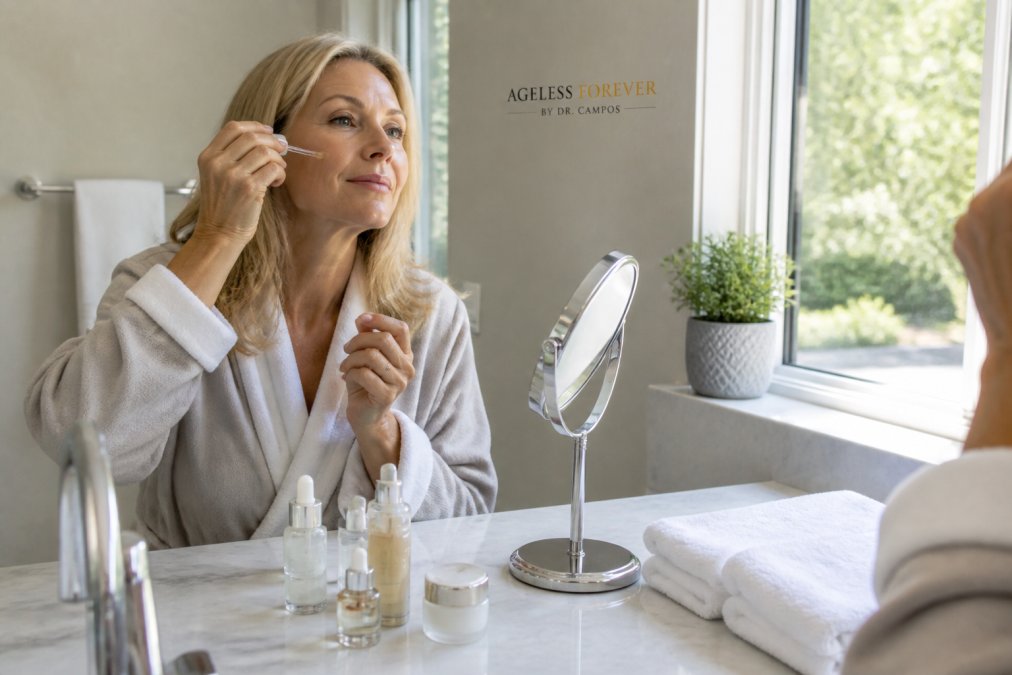
A dermatologist-recommended sun damage routine pairs antioxidant protection in the morning with repair-focused actives at night: vitamin C and SPF shield skin during UV hours, while retinoids and peptides work overnight.
Morning Routine
- Gentle cleanser.
- Vitamin C serum.
- Moisturizer with niacinamide.
- Broad-spectrum SPF 50.
Evening Routine
- Gentle cleanser.
- Retinoid, two to three nights weekly at first.
- Peptide or barrier-repair moisturizer.
The Skin Cancer Foundation's prevention guidelines reinforce that daily broad-spectrum SPF is the single most effective step in any sun damage plan, morning routine or not.
Professional Skincare for Sun Damage: What Sets Clinical Formulas Apart
Professional skincare for sun damage differs from drugstore products in active concentration, delivery systems, and formulation stability. Clinical-grade formulas typically carry higher percentages of proven actives and are built to keep them stable and penetrating effectively, a real difference, but one with trade-offs worth understanding.
Concentration: More Is Not Automatically Better
A higher percentage of an active only helps if your skin can tolerate it long enough to see results. A few examples:
Daily Essential Mineral Tinted Sun →
- Vitamin C: L-ascorbic acid is typically effective in the low-to-mid teens as a percentage of the formula. Below that, antioxidant benefit drops off; far above it, irritation and instability rise. Formulation matters as much as the number.
- Retinoids: Prescription-strength tretinoin is far more potent than over-the-counter retinol, and far more likely to cause peeling and redness in the first weeks. A weaker retinoid used consistently often beats a stronger one used twice and abandoned.
- Niacinamide: Well tolerated across a wide range, which is why it appears in both drugstore and clinical formulas. Concentration is less of a differentiator here than in retinoids or vitamin C.
Delivery Systems and Stability
This is where clinical formulas most often separate from mass-market products, and where the difference is hardest to see on a label:
- Airless and opaque packaging protects oxygen- and light-sensitive actives like vitamin C and retinoids from breaking down before you finish the bottle.
- Encapsulation slows an active's release so it penetrates over time instead of all at once, reducing irritation while keeping it working.
- Penetration enhancers help larger molecules cross the outer layer of skin, which is why two formulas with the same ingredient list can perform very differently.
- pH control determines whether an active is stable and can penetrate. A vitamin C serum at the wrong pH is unstable or ineffective, regardless of concentration.
The Trade-Off Nobody Mentions
Clinical formulas are not automatically gentler or better for every skin type. Higher concentrations and stronger delivery can mean more irritation, especially for sensitive or compromised skin. The right move is often to start a clinical formula at a lower frequency, two or three nights a week for a retinoid, rather than start with a weaker product and never build tolerance.
How to Read a Clinical Formula Label
A few things worth checking before you commit to a product:
- Where is the active on the ingredient list? Ingredients are listed by concentration, so an active near the bottom is likely present in a token amount.
- Is the packaging protective? Airless pumps and opaque bottles signal the brand is thinking about stability.
- Is there a stated concentration? Reputable clinical brands usually disclose it.
- Does the formula include barrier support? Ceramides, niacinamide, and soothing agents make higher-concentration actives easier to tolerate.
- Is there a clear introduction schedule? A brand that tells you how to ramp up usually expects its actives to work.
Skin Type-Specific Protocols for Sun Damage
Skin type changes which actives you can tolerate and how fast you can introduce them. The same retinoid that transforms oily, resilient skin can wreck a sensitive complexion if started at the wrong frequency.
| Skin Type | Priority Actives | Introduce How | Watch For |
|---|---|---|---|
| Oily | Retinoids, niacinamide, salicylic acid | Full strength, 3x weekly | Over-drying from too many actives |
| Dry | Hyaluronic acid, ceramides, peptides | Retinoid 2x weekly, buffer with moisturizer | Flaking and barrier irritation |
| Sensitive | Niacinamide, mineral SPF, soothing gels | One active at a time, patch test first | Redness, stinging, heat |
| Combination | Vitamin C, niacinamide, gentle retinoid | Alternate actives by night | Oiliness in the T-zone, dryness on cheeks |
| Post-procedure | Soothing gel, mineral SPF, barrier cream | Wait for clearance, then rebuild slowly | Sun exposure during recovery |
Post-Treatment Recovery: Supporting Your Skin After In-Office Procedures
Recovery support determines how much of your in-office result you keep. After laser resurfacing or a chemical peel, the epidermal barrier is compromised and skin is far more vulnerable to UV exposure, which can undo weeks of progress in a single unprotected afternoon.

Conclusion: Building a Professional Skincare for Sun Damage Plan That Lasts
The hardest part of repairing sun damage isn't finding the right ingredients. It's staying consistent long enough for cellular turnover to show results, and protecting skin well enough that new damage doesn't outpace the repair.
Frequently Asked Questions
Can professional skincare products actually reverse sun damage?
Professional skincare can visibly improve sun damage, though complete reversal isn't realistic. Clinical-grade formulas with retinoids, vitamin C, and peptides support cellular turnover, collagen production, and melanin regulation, which fades hyperpigmentation and softens fine lines over time. Sun damage skincare works best as ongoing care: consistent use of broad-spectrum SPF 50 and targeted treatments helps your skin repair itself while preventing new UV damage from undoing your progress.
What ingredients should I look for in skincare for sun-damaged skin?
Prioritize antioxidants like vitamin C, green tea, and CoQ10 to neutralize free radical damage. Retinoids support cellular turnover and collagen production. Niacinamide and ceramides reinforce the epidermal barrier. Hyaluronic acid and squalane restore moisture. DNA repair enzymes and peptides help skin recover from UV exposure. Zinc oxide and titanium dioxide provide broad-spectrum SPF protection. A professional skincare for sun damage routine combines several of these rather than relying on one ingredient alone.
How long does it take to see results from professional skincare for sun damage?
Most people notice improved hydration and skin texture within two to four weeks. Visible changes in hyperpigmentation, fine lines, and skin tone typically take eight to twelve weeks of consistent use, since cellular turnover and collagen production operate on longer cycles. Post-treatment recovery products like soothing gels can calm redness within days. Photographic documentation every four weeks helps track subtle progress that's easy to miss in a mirror.
What is the difference between medical-grade and over-the-counter skincare?
Medical-grade formulas deliver higher concentrations of active ingredients with better penetration into the dermal layers, backed by clinical testing. Over-the-counter products often use lower concentrations due to regulatory limits on certain actives. This doesn't make OTC products useless, but if you've tried them without results, a dermatologist-developed line may bridge the gap. Look for brands formulated by clinicians who understand how ingredients interact with skin biology, not just marketing trends.