



Table of Contents
- What Makes a Skincare Brand Medical-Grade?
- Medical-Grade Skincare Ingredients That Show Clinical Results
- Medical-Grade vs. Over-the-Counter Skincare: What Actually Differs
- How to Build an Anti-Aging Skincare Routine That Works
- Ingredient Interaction Safety and Long-Term Cost Considerations
- Choosing Medical-Grade Skincare Products for Your Skin Concerns
- Frequently Asked Questions
Last Updated: September 13, 2026
What Makes a Skincare Brand Medical-Grade?
Medical-grade skincare is a category of professional-strength formulations made with higher concentrations of active ingredients and validated through clinical testing, rather than consumer marketing trends. This guide from Ageless Forever by Dr. Campos breaks down which brands back their claims with evidence, which ingredients actually deliver, and how to build a routine that produces visible anti-aging results.
The term "medical-grade" carries no legal definition in the United States, which is exactly why so many brands use it loosely (the FDA). What separates a genuinely clinical line from a cosmetic one comes down to three things: the concentration of active ingredients, how those ingredients are delivered into the skin, and whether the brand publishes testing data to support its claims. A FDA overview of cosmetics versus drugs clarifies that products making structural claims about the skin are regulated differently than those that only affect appearance.
Clinical Trials and Evidence-Based Formulations
A brand earns the medical-grade label by testing its formulas and publishing results. Look for companies that run controlled trials, measure outcomes objectively, and share findings rather than leaning on testimonials alone. Formulation stability matters too: an active ingredient that degrades in the bottle delivers nothing by the time it reaches your skin.
Dermatologist-Recommended vs. Marketing Claims
Dermatologist-recommended is a meaningful signal only when you can trace it to a specific expert and a specific reason. A vague "recommended by dermatologists" badge proves little. What matters is whether the formulator has clinical credentials and whether the formula's actives appear at concentrations shown to work in published research.
Medical-Grade Skincare Ingredients That Show Clinical Results
The ingredients that actually change aging skin fall into a few well-researched families. Retinoids, peptide complexes, antioxidants, growth factors, and barrier-supporting lipids each address a different part of the aging process, and the strongest formulas combine them thoughtfully.
Retinoids and Peptide Complexes for Collagen Production
Retinoids remain the most studied topical ingredient for fine lines and wrinkles. They accelerate cellular turnover and support collagen production, but they demand careful introduction. Encapsulated retinol is gentler than free retinol because it releases slowly, reducing irritation. Ageless Forever by Dr. Campos formulates its Refine + Renew line in three strengths, from a 0.5% gelée serum for newcomers to 2.5% lipid drops for experienced users, so you can match potency to your skin's tolerance.
Peptide complexes work differently. Copper tripeptide-1 (GHK-Cu) signals the skin to rebuild collagen and elastin, which supports firmness and elasticity over time. The RENAURÉ™ Copper Peptide Cell Renewal Serum pairs 1% GHK-Cu with oligosaccharides studied for their effect on facial volume.

Antioxidants, Growth Factors, and Skin Barrier Support
Antioxidants defend against oxidative stress, the daily damage from UV exposure and pollution that accelerates photoaging. Vitamin C, green tea polyphenols, and Co-Q10 are the workhorses here. Barrier support matters just as much: ceramides, squalane, and hyaluronic acid keep the skin's protective layer intact so actives can do their job without triggering sensitivity.
Medical-Grade vs. Over-the-Counter Skincare: What Actually Differs
The real difference between medical-grade and over-the-counter skincare comes down to penetration depth, bioavailability, and pH balance, not the label on the box. A drugstore moisturizer can hydrate beautifully, but its actives often sit on the surface rather than reaching the dermal layer where collagen is built.
Penetration Depth, Bioavailability, and pH Balance
Bioavailability describes how much of an active ingredient actually reaches its target in a usable form. A formula's pH balance determines whether certain actives stay stable and whether they can cross the skin barrier. Retinoids and vitamin C, for example, perform best within specific pH ranges, and a poorly buffered formula wastes the ingredient. Clinical-strength products are built around these variables; mass-market products are built around shelf appeal and texture.
Three mechanisms separate the two categories in practice:
- Molecular size and vehicle design. The stratum corneum only lets through molecules below a certain size unless the formula uses a penetration enhancer or a liposomal carrier. Many mass-market actives are simply too large to travel past the surface.
- Concentration at the target site. A label can list an impressive ingredient while delivering a fraction of it to the dermis. Encapsulation, time-release beads, and lipid delivery systems are what keep an active intact long enough to work.
- Stability over the product's life. Retinol, vitamin C, and growth factors degrade with light, heat, and oxygen. Clinical lines typically use airless pumps, opaque packaging, and antioxidant buffering to preserve potency; jar packaging and clear bottles accelerate breakdown.
| Factor | Over-the-Counter | Medical-Grade |
|---|---|---|
| Active concentration | Lower, cosmetic levels | Higher, clinically studied levels |
| Penetration depth | Mostly epidermal | Targets dermal layer |
| pH optimization | Rarely specified | Formulated for stability |
| Delivery system | Basic emulsion | Encapsulation, liposomes, time-release |
| Packaging | Often jar or clear bottle | Airless pump, opaque, antioxidant-buffered |
| Testing data | Marketing claims | Clinical trials and published results |
What the Label Does and Does Not Tell You
The term "medical-grade" has no legal definition, so the label alone proves nothing. What you can verify is whether the brand publishes its active concentrations, names its delivery technology, and shares before-and-after data from controlled use. If a product lists an ingredient without a percentage and without a stability claim, treat the marketing as aspirational rather than clinical.
A FDA overview of cosmetics versus drugs explains that products making structural claims about the skin are regulated differently than those that only affect appearance, which is why genuinely clinical lines tend to describe their formulas in the language of mechanism and measurement, not mood.
How to Build an Anti-Aging Skincare Routine That Works
An effective anti-aging routine follows a simple rhythm: protect during the day, repair at night. Consistency over months, not days, is what produces visible change in fine lines and firmness.
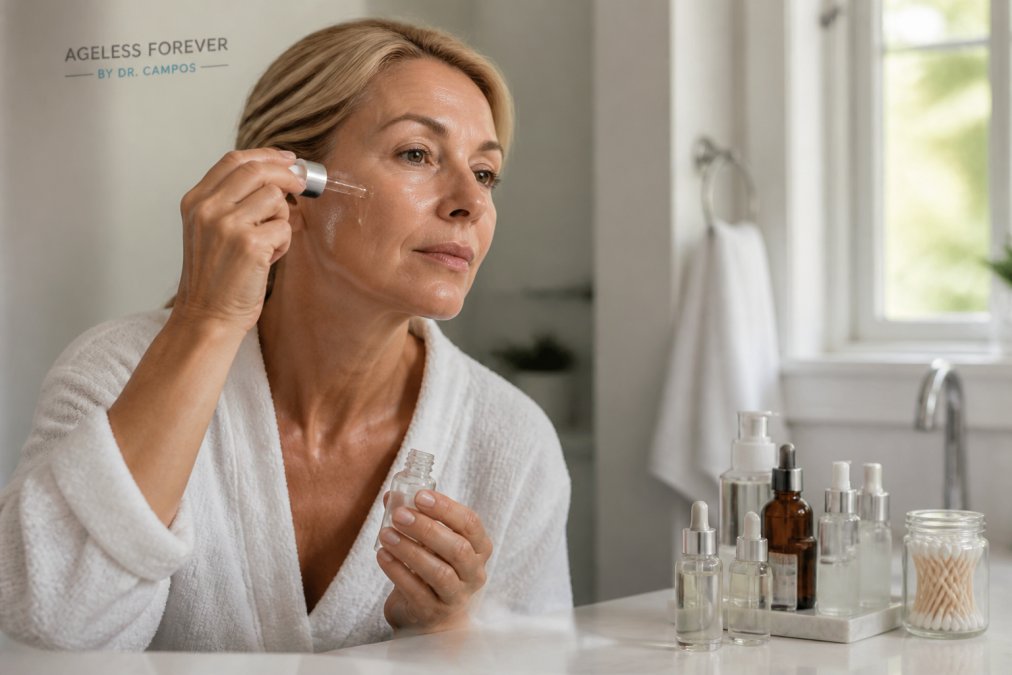
Morning Protection and Evening Repair
Mornings start with a gentle cleanser, an antioxidant serum, a moisturizer, and broad-spectrum protection. The Lightweight Brightening Sun Shield SPF 50 in the Antiaging Essentials Set uses 14.5% zinc oxide to guard against the UV damage that drives most visible aging. Evenings shift to repair: cleanse, apply your retinoid or peptide serum, then seal in moisture with a barrier-supporting cream.

Transitioning from Drugstore to Clinical Products Safely
Moving from drugstore to clinical products works best in stages. Start with a clinical cleanser and moisturizer for two weeks. Add an antioxidant next, then introduce a retinoid at the lowest strength. Patch testing on the inner forearm before full-face use catches reactions early. If your skin is recovering from an in-office treatment, begin with barrier-focused formulas and hold off on retinoids until sensitivity fades.
Ingredient Interaction Safety and Long-Term Cost Considerations
Mixing certain actives causes irritation without adding benefit. Retinoids and strong exfoliating acids used in the same session, for instance, can compromise the skin barrier. The safer pattern is to alternate: acids on some nights, retinoids on others, with barrier repair in between.
How to Layer Professional-Strength Actives Without Irritation
Most irritation people attribute to "sensitive skin" is actually an interaction problem. A few pairings are well understood:
- Retinoids + exfoliating acids (AHA/BHA). Both accelerate turnover. Used the same night, they strip the barrier faster than it can rebuild. Alternate nights and keep a barrier cream in the rotation.
- Retinoids + vitamin C. Both are potent, and both can sting when layered directly. Many practitioners recommend vitamin C in the morning and the retinoid at night to separate them entirely.
- Retinoids + growth factors or copper peptides. These can be complementary, but only when introduced sequentially. Start the retinoid first, stabilize for several weeks, then add the peptide serum on alternate nights.
- Niacinamide + strong acids. Generally well tolerated together at moderate concentrations, but high-dose niacinamide plus a low-pH acid can trigger flushing in reactive skin.
- Benzoyl peroxide + retinoids. Benzoyl peroxide can degrade certain retinoids on contact. If you use both, separate them by time of day.
The safe pattern is one new active at a time, two weeks between additions, and a barrier-focused product always in the routine as a fallback.
The Cost-Per-Use Math Most Buyers Never Run
A clinical regimen costs more per bottle, but the comparison that matters is cost per use, not cost per ounce. Concentrated formulas typically call for two to three drops per application rather than a generous pump, and a well-formulated serum often lasts two to three months of daily use. A mass-market serum may cost less up front but require more product per application and deliver less active per drop, so the per-use gap is smaller than the sticker price suggests.
Three variables drive the real long-term cost:
- How long the bottle actually lasts. Track your start date. If a serum is gone in six weeks, your true monthly cost is higher than the label implies.
- How many products you need to see a result. A single well-formulated multi-active serum can replace two or three single-ingredient products, which often narrows the total monthly spend.
- How much you waste on products that do not work. The most expensive routine is the one you abandon after a month because it irritated your skin or showed no change.
Over a year, a focused clinical routine with three or four well-chosen products frequently lands close to a drugstore routine built from six or seven overlapping items, and the clinical routine is the one formulated to deliver measurable change. Ageless Forever by Dr. Campos backs its line with a money-back guarantee, which lowers the risk of trying a higher-tier regimen.
Choosing Medical-Grade Skincare Products for Your Skin Concerns
Matching products to your specific concerns beats buying whatever ranks highest. Hyperpigmentation responds to retinoids and niacinamide. Loss of firmness calls for peptide and copper tripeptide formulas. Dryness and a compromised barrier need ceramides and hyaluronic acid first, with actives added later.
For most people building a first clinical routine, the Age Reversing Set at $364.95 covers the essentials: a barrier-restoring cleanser, an antioxidant mist, a lifting peptide serum, an eye cream, a replenishing cream, and SPF 50, plus an internal supplement. Those focused on firmness and volume can start with the RENAURÉ™ Age-Reversing Duo at $149.95, which pairs the copper peptide serum and crème for morning and evening use. If you are unsure where your skin fits, an advanced skin analysis removes the guesswork.

Frequently Asked Questions
Does medical-grade skincare really make a difference compared to drugstore brands?
Yes, the difference comes down to concentration and delivery. Medical-grade formulas typically contain higher percentages of active ingredients like retinoids, peptides, and vitamin C, and they are designed with penetration depth in mind so those ingredients reach the dermal layer. Over-the-counter products often use lower concentrations to suit a broader audience. If you want visible improvement in fine lines, hyperpigmentation, or firmness, clinical-strength formulations tend to produce results faster, though consistency matters more than any single product.
What medical-grade skincare ingredients should I look for in anti-aging products?
Focus on ingredients with evidence behind them: encapsulated retinoids for cellular turnover, copper peptides and growth factors for collagen production, vitamin C and ferulic acid for antioxidant efficacy, and niacinamide for skin barrier function. Hyaluronic acid supports hydration, while broad-spectrum protection prevents further photoaging. A well-formulated product combines several of these rather than relying on one hero ingredient. Check that the brand lists concentrations and explains how the formula stays stable, because formulation stability directly affects how well those ingredients perform on your skin.
How long does it take to see results from medical-grade anti-aging skincare?
Most people notice improved hydration and texture within two to four weeks. Fine lines and wrinkles typically respond over eight to twelve weeks, and hyperpigmentation can take three to six months of consistent use. Retinoids in particular require a gradual introduction, often starting two to three nights per week, to let your skin adjust. Patch testing before adding a new active helps you catch skin sensitivity early. Results depend on your starting point, how consistently you apply the products, and whether you protect your skin from UV exposure daily.
Can medical-grade skincare replace professional in-office treatments?
Medical-grade skincare is best understood as a complement to professional treatments, not a replacement. In-office procedures can deliver results that topicals alone cannot reach, but the results fade faster without proper home care. A clinical-strength routine with retinoids, peptides, and antioxidants helps maintain and extend what you achieve in a provider's office. If you have recently had a procedure, ask your provider which products are gentle enough for post-procedure skin, since barrier function is compromised during recovery and harsh actives can cause irritation.
Aging skin needs formulas built on evidence, not marketing, and finding them takes more than reading a label. Ageless Forever by Dr. Campos develops its line around clinical-grade actives, from the 1% GHK-Cu in the RENAURÉ™ serum to the encapsulated retinol in the Refine + Renew series, and pairs every product with a money-back guarantee. Get started with Ageless Forever by Dr. Campos and build a routine that delivers visible results you can maintain at home.